
Q3'26: America's Gambit

By: Jack Schibli
As a reminder, this blog is an outlet for our thoughts, primarily on the macroeconomic environment, which contextualizes our investments. Please subscribe via the form at the bottom of the page to receive future post notifications.
If you are interested in learning more about our investment strategies, please kindly fill out our contact form here.
It’s time to revisit the topic at the center of global attention – artificial intelligence (AI). Last year, we discussed the risks to the AI data center buildout, which primarily fell into the following categories: 1) frontier model improvements vs. open source, 2) hardware-level efficiency gains, and 3) timing of the adoption curve. All three risks remain but have done little to persuade those spending CapEx dollars to slow down.
TLDR: – "too long; didn’t read."
- AI data centers have attracted enormous sums of capital, now increasingly financed by debt, to significantly expand AI computing capacity.
- Demand for AI must rise dramatically over the next five years for said capital just to breakeven.
- We are concerned that the build out is not considering the effective increase in compute capacity gained via innovation throughout the stack.
- Meanwhile, models appear to be commodities, inciting a race to the bottom in pricing.
- We posit AI has yet to find product market fit at the enterprise level and needs to do so fast to match the growth in capacity and debt service costs.
- What does a world where AI is ubiquitous and cheap look like? We ponder the impacts on the economy and society.
- P.S. During the writing of this piece, AI data center related stocks have sold off significantly and perhaps now reflect a more balanced view of the many puts and takes to this CapEx cycle discussed below.
The Cold Hard Math 🧊
The AI investment cycle is hotly debated, and rightfully so. It’s critical to the stock market: 43% of the S&P 500 and 61% of the Nasdaq 100, by market capitalization, are involved in the AI data center buildout. Likewise, it’s key to U.S. GDP growth both directly through spending and reflexively through the wealth effect from equities.
We will be the first to admit that the pace and magnitude of committed capital spend has far, far outpaced what we believed was possible. We underestimated the game theory at stake. No player in this game wants to risk being left behind by their peers on the road to superintelligence, and so if one party is spending like a drunken sailor, all parties must follow. This raises the question – is anyone actually doing the ROIC (“Return on Invested Capital”) math?
The math is complicated, and part of the difficulty is that identifying total “committed” capital requires deciphering the circular nature of these “deals.” Instead, we estimate a spend figure based on datacenter activity tracking. Per Cleanview’s U.S. datacenter tracker, there is currently ~64 GW (gigawatts) of operating capacity, of which we estimate approximately 22 GW are AI-based datacenters. Meanwhile, the same data suggests over 412 GW of planned capacity, of which we estimate 350 GW are AI-based data centers. Note that much of the “planned capacity” is likely a decade or more away. How many GW will come online by 2030? Power analysts suggest that without new utility-scale power or other behind-the-meter solutions, adding more than 15 GW per year to the grid would be difficult, putting the low end of additional capacity by 2030 around 65 GW. Though Elon Musk claims SpaceX alone will add 13 GW between now and the end of 2027[1], and others have equally lofty goals. We assume a cumulative addition of ~100 GW between now and 2030, or almost 5x of today’s capacity. Using Jensen Huang’s oft-quoted rule of thumb – $60B build cost per GW – that implies existing plus planned total spend of $6.3 trillion for the period of 2024-2030 and roughly $1.2 trillion annually going forward – equivalent to ~3.70% of U.S. GDP.
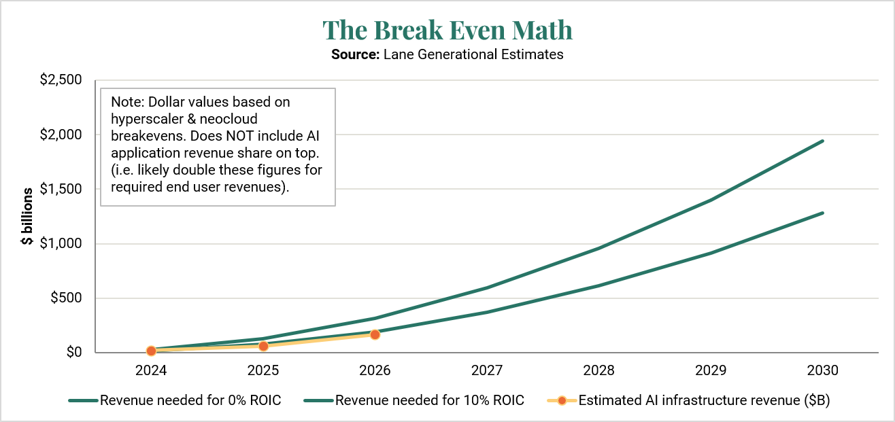
With our spending estimate in hand, we can model out required revenues by 2030 for various ROIC levels. Our core assumptions are as follows: the cost to build a data center inflates 5% per year, total IT equipment cost of 78% of total build cost, a useful life of IT equipment of 5 years (per hyperscaler accounting depreciation schedules), operating costs of 15%, and a stable federal tax rate (21%). We calculate required infrastructure-only AI revenue in 2030 of $1.2 trillion to break even – this does not include any additional margin that an application or model provider would add on top. Therefore, actual end-user AI revenue required is likely to be roughly double these figures, assuming a ~50% margin.
We are likely undercounting both costs and revenue here, but the relative relationship is a good reference point. Annual AI infrastructure revenue needs to grow roughly 8x by 2030 to break even – not outside the realm of possibility with a strong adoption curve. Today’s AI revenue appears disproportionately driven by a small number of firms: Ramp’s AI index shows the top 1% spend over $9,500 per employee per month, while the median firm spends just $15.70 per employee per month. That statistic alone isn’t very worrisome, but combined with the fact that over 80% of the top 1% of AI spenders are VC-backed startups, some might begin to question the durability of that revenue.
The financing source for the datacenter buildout has shifted from hyperscaler cash flow to debt, as 2026 marks the first year hyperscaler capital expenditures will exceed cash flow. Many have resorted to creative financing routes through joint ventures, special-purpose vehicles, and other off-balance-sheet liabilities. This hides debt at the parent level, allowing hyperscalers to maintain their surface-level capital-light appearance, when in fact they have become heavily capital intensive. In fact, they have expressed a willingness to pay higher interest rates to maintain this mirage than they would have had they just issued direct investment-grade debt[2]. The shift from equity and cash financing to debt financing materially raises risks if expectations are not met. Debt service costs are fixed, and project-level forecasts rest on a set of very uncertain assumptions, such as utilization rates, token rates, renewal rates, and residual values.
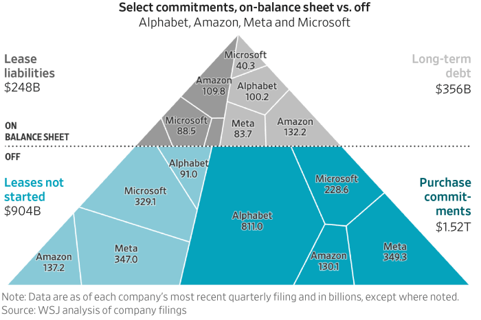
To date, spending has mostly benefited data center picks and shovels providers. The entire semiconductor chain, along with networking and optics, has seen massive step changes in demand. Many parts of the supply chain, particularly the GPUs themselves, are currently limited by the annual production capacity of fabs like TSMC. This has created scarcity pricing and driven massive expansions in semiconductor gross margins, while unit volumes are only up modestly. We used consensus estimates to build up to a rough total of CY2028 semiconductor U.S.-only sell-in data center revenues of $1.19 trillion. This figure is likely too high if overall datacenter spend is roughly $1.2 trillion and the semiconductor component excludes buildings and power. Additionally, our semiconductor consensus estimate does not account for the long list of hyperscalers (and now model companies) increasingly diverting capex dollars to internal chip programs. We also highlight reports that Nvidia is effectively stuffing the channel: Amazon reports over $5 billion in GPUs purchased in August that cannot be plugged in, plus $3B more per month “for the foreseeable future.” These are referred to as “dark GPUs”, sitting idle in a warehouse, and signal a pull-forward in Nvidia revenues – stuffing the channel is rarely a winning strategy.
To sum up, the amount of capital deployed, and how it’s being financed, leave little room for error or any speed bumps along the way. Next, we’ll dive into what a few of those speed bumps might look like.
Red Sky in Morning, Sailors Take Warning ⛵
Commoditization:
In our view, the same risks we highlighted over a year ago remain front and center. The first is that models will converge toward commoditization. This is the frontier lab vs. open-source debate. As you can see below, open source continues to lag frontier labs’ model performance by roughly six months.
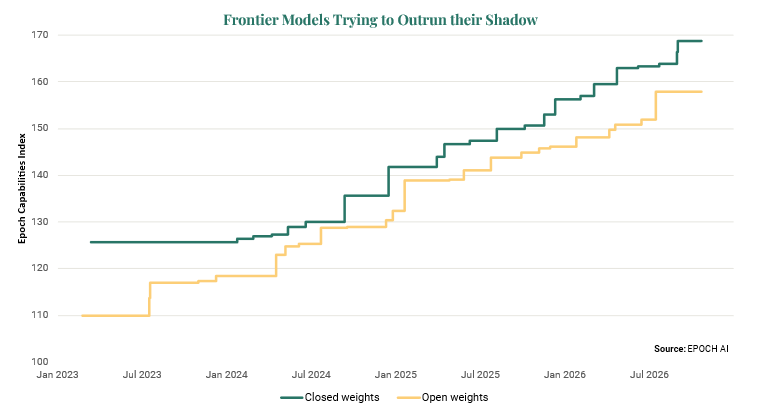
With each model generation, open-source models become more capable, meaning they can competently complete a larger percentage of tasks. We believe open-source models will soon complete 95%+ of tasks, and a small percentage of highly complex tasks may remain reserved for frontier models. Open-source models are free to use; you just pay the compute cost to run them, whereas frontier models charge a premium on top of compute costs to access them. Spending exponentially more money on each generation of models, only for a free version to come out six months later, isn’t exactly a battle-tested business model. The entire gambit really blows up if each new generation brings little progress or differentiation. We posit models are commodities, as they exhibit the following defining traits of a commodity: 1) standardization - it’s difficult to tell models apart; 2) low switching costs; 3) low barriers to new supply. A year or so ago, Anthropic and OpenAI were the only two major frontier labs – today, Google, Meta, and SpaceX all have comparable models. Similarly, dozens of serious model contenders have entered the race via open-source and context training. For example, the small team at Paper Instruments recently released Ultramarine Flash 1, a model built on an open-source base and trained exclusively on knowledge worker tasks (e.g. legal, accounting, tax, finance, consulting). It outperforms frontier models on knowledge worker benchmarks; did we mention it will be free to use and cost the team only $300k to build?
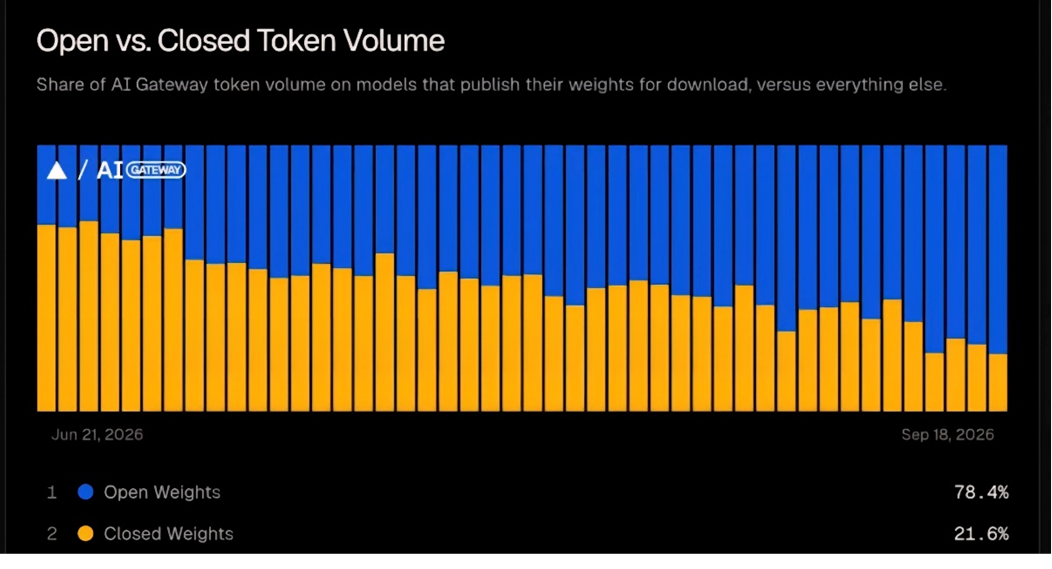
Commoditization drives intense competition and a race to the bottom in pricing, though ironically, open-source is already free! Perhaps the AI boom should be viewed as a commodity cycle; in that case, one might study the shale boom and bust cycle of 2010-2020. The open-source commoditization threat puts the two largest capital spenders, Anthropic and OpenAI, in the crosshairs. The two have committed to spend $600 billion and $750 billion, respectively – a meaningful share of total ecosystem CapEx. A central risk is that these firms may be unable to generate enough revenue (let alone cash flow) to pay for the compute capacity they have already committed to. Note – if you believe our argument here, private markets (and perhaps soon, public markets) are making a grave mistake valuing these companies with a traditional VC-based SaaS framework (i.e., exceptionally high ARR multiples). Lastly, enterprises have realized that relying on a closed frontier model not only raises costs but also exposes sensitive data, relinquishing privacy controls. This has already led to a meaningful shift in token consumption from frontier models to open-source alternatives.
Efficiency Gains
Our next highlighted key risk is efficiency gains throughout the stack. We believe capitalism will seek efficiency at every level, and the ecosystem is vastly underestimating the innovation that will occur over the next several years, all of which will serve to increase the effective supply of available compute.
There are various measures of efficiency. First, there is cost per token (usually quoted as cost per million), where tokens are units of text measured on an input (user prompt) and output (AI response) basis. Cost per token is impacted by things like model efficiency and serving stack efficiency. Next, tokens produced per GPU hour measures how effectively the GPUs computing power is being utilized. Cost per token times tokens per GPU equals revenue per GPU hour. The chart below shows how revenue per GPU-hour has remained stable while token prices have collapsed; tokens produced per GPU have increased to offset the decline in token price. However, this likely reflects a relatively constant supply of GPUs over the brief measurement period.
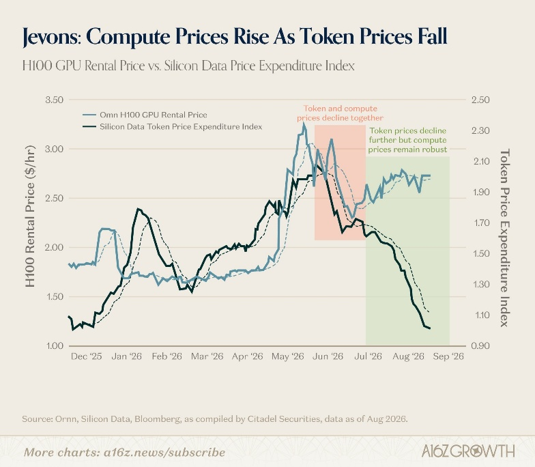
Have you noticed the average AI response has gotten longer? Since tokens are the base unit of revenue models, model and compute providers are incentivized to increase output token length. Epoch AI data shows that average non-reasoning model token output grows 2.2x per year, average reasoning model output grows 5x per year, and that reasoning models produce nearly 8x more tokens on average than non-reasoning. Most of this token usage happens behind the user’s view, as reasoning models produce a chain-of-thought, burning tokens at each step of the way, before synthesizing a response. Recent research found that auditing this hidden token usage is very difficult, and the author’s tests suggest it could be inflated by over 15x without detection. We find this level of token inflation to be unsustainable over the long term.
Another measure of efficiency is tokens per MW, tokens per GPU hour divided by that GPU's power draw, which measures the overall efficiency of the entire datacenter stack. Thus, token cost per MW can also improve through power efficiency gains. At the chip level, this has already proven true. Nvidia’s Blackwell generation is up to 25x more energy efficient than the prior Hopper generation, and the upcoming Rubin is purported to be 10x more energy efficient than Blackwell.
GPUs may not even be the most efficient chip design for AI. The GPU is designed around what’s called Von Neumann architecture, which effectively means memory and compute are separate. The neural net constantly pulls data from memory, moves it to the compute cores, performs the matrix multiplication, and writes the results back to memory. This data movement uses 10-100x more energy than the logic operation itself[3]. GPUs, originally designed for gaming, support high-precision, deterministic floating-point math, which suits AI training well. However, AI inference has lower arithmetic intensity and greater precision intolerance, opening the door to different chip architectures. For example, Compute-in-memory (CiM) performs the arithmetic where the data is stored, dramatically reducing energy consumption and the required amount of High-Bandwidth Memory (HBM). Scaling this infrastructure has been challenging, but we suspect it may resolve over time because the incentives for success are so great.
Another undiscussed avenue for efficiency gains is how enterprise customers actually use GPUs. Just as chip scarcity has driven hyperscalers to secure all available supply, regardless of whether they can even plug the chips in yet, we believe enterprises are securing compute via long-term contracts far in advance of needing it. This purchasing behavior is driven by fear of running short on compute later, likely exacerbated by aggressive hyperscaler sales tactics. Hyperscalers proudly claim they are selling out of all available compute capacity, but buyers appear to underutilize what they’ve reserved. A study by Cast AI analyzed tens of thousands of enterprise clusters across AWS, Azure, and GCP and found that the average GPU utilization was just 5%! We acknowledge that 100% utilization is unlikely, as it would mean running at full capacity for 24 hours, so a 50% utilization target is more realistic. This still implies the average enterprise cluster can increase GPU utilization 10x before needing to purchase more compute.
Lastly, we would be remiss not to mention the possibility that a growing share of inference demand may never reach the data center at all. Each year, we have seen significant leaps in the ability to run high-performance LLMs locally on an edge device, such as a laptop. A compression technique called quantization stores model weights at 8 or 4 bits instead of 16, significantly reducing memory needs at the expense of some performance. Quantization can also be applied to the existing GPU capacity to increase token throughput per GPU. We suspect edge chip capability will only improve, as will the ability to “shrink” these models with less performance drag. The average consumer may ultimately interact with AI almost solely on a local phone or laptop, with infrequent calls to the cloud for complex tasks.
Looking ahead, both GPU-hours and available MWs are set to expand dramatically as new data-center capacity comes online. Therefore, token demand growth must outrun both efficiency gains across the stack multiplied by new supply of that stack (GPUs/MWs).
Demand Adoption Curve
This brings us to our last cited key risk – the timing of demand adoption. To be clear, we think demand, measured in tokens, will increase dramatically every year over the next decade, but will it grow at a rate that matches supply, measured by stack efficiency gains times new available compute? We believe there may be an air pocket, where token demand does not match embedded expectations in the required timeframe. As noted above, our model suggests over 5x growth in compute capacity by 2030, and if efficiency gains lift output per chip just 2x per year, the industry must sell over 80x as many tokens as today to absorb new supply, and maintain stable token pricing.
We suspect most enterprises have yet to lean into AI spend because they haven’t realized tangible productivity gains, either via additional revenue or cost savings. We believe AI productivity gains will come overwhelmingly from cost savings rather than additional revenue, because AI tools ultimately replace labor. The most immediate TAM (total addressable market) for AI is the knowledge worker, but unemployment in this cohort has barely budged so far. In fact, unemployment for workers with a bachelor’s degree fell year-over-year to 2.5% in September, from 2.8% last year. For illustrative purposes, our $1.2 trillion annual breakeven revenue estimate in 2030 is the equivalent of 9.6 million knowledge workers at $125,000 per year. According to the Challenger Job reports, AI has been cited in fewer than 200,000 announced job cuts since 2023[4].
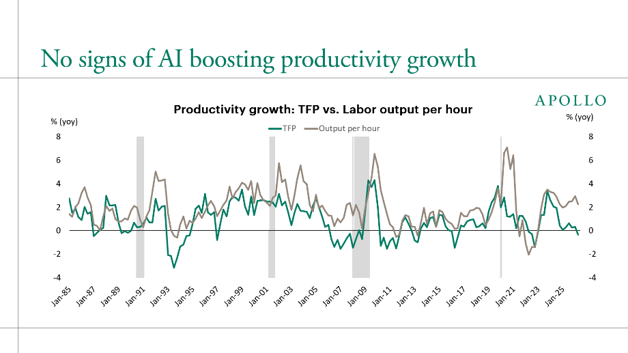
Outside of software engineering, it appears AI has yet to find true product market fit within the enterprise. We believe employees are using these tools to help complete their work, but not necessarily completing additional work. This may be for a variety of reasons, including difficulty demonstrating tangible return on investment, privacy and security concerns, and long and bureaucratic implementation cycles. We believe that, to fully realize the benefits of AI, enterprises must redesign from the ground up: far leaner organizations built around an central AI-native operating layer, discarding software, systems, and structures they have relied upon for decades. On the consumer front, chat bots have found mass usage, but only a small percentage of users pay. Fully-fledged personal assistants appear to be the natural next step, which have recently launched through products like Grok Bot and Meta’s Muse. These agents are only useful with deep access to your email, calendar, payments and accounts, a tradeoff many consumers may not be ready to make. This is also another reason private and local AI, where that type of data never leaves your device, may gain share.
Cumulatively, these risks compound, as commoditization drives a race to the bottom in pricing, efficiency gains multiply the supply of effective compute, and adoption has been moving rather slowly. None of this means AI demand disappoints in absolute terms over the long term; we expect consumption to grow dramatically. The risk is timing and price of that demand, which in a debt-funded cycle must at least keep pace with debt servicing costs. We also note that a unique characteristic of this capex cycle has been the shortage of new supply, limited both by semiconductor fab throughput and the long development timeline to bringing a new data center online. These bottlenecks have postponed any supply gluts, and may continue to throttle back new capacity and ease any demand/supply mismatch in the years ahead.
2050: It’s AI’s World; We’re just Living in It 🤖
We believe expectations for the datacenter trade have finally caught up to or exceeded what might be realistic over the next few years. However, over the longer term, we need to consider a world where intelligence is a utility, converging on the price of energy. If AI is ubiquitous, who wins and who loses? These are difficult questions to answer for both the economy and our society at large.
To be explicit, we believe artificial intelligence is the most transformational technological breakthrough of our lifetimes, and possibly in human history. It is likely to enable technological progress across the sciences (physics, math, biology, etc.) at a nearly incomprehensible rate. Unlike previous technological revolutions, AI quite literally replicates and improves upon human ability, rather than just improving efficiency. Today, this replacement capability most immediately threatens knowledge workers, whose daily tasks revolve around a computer, but in the future, giving artificial intelligence a human form factor via robotics may threaten physical labor. As noted above, enterprises have been slow to adopt AI in the workplace, and we haven’t yet seen major layoffs, though the hiring rate for entry-level knowledge workers in AI-exposed fields has declined by over 12% since the launch of ChatGPT. We believe AI will continue to penetrate the knowledge worker labor force, with each performance advance climbing another rung on the corporate ladder. As a potential growth slowdown looms, we highlight that companies tend to lean heavily into technology during recessions in search of productivity gains. We fear that in the next economic slowdown, many jobs will be lost and never return.
We also believe AI is, and will remain, unevenly distributed across society. Highly skilled, highly motivated knowledge workers are well suited to supercharge their capabilities, while those who lack domain expertise or the necessary entrepreneurialism to prompt intelligence may fall further behind. Likewise, those with greater access to capital now have greater access to compute, which means greater access to intelligence. It’s hard to see a future where today’s record inequality doesn’t worsen. We don’t have solutions to these problems. Elon Musk is already pushing the narrative that AI will usher in the need for Universal Income, which comes with its own complications.
The way humans interact with computing may also drastically change. Until now, the world has developed both hardware (desktops, keyboards, mice, etc.) and software (user interfaces, dashboards, etc.) around the human computing experience. Users click actions, type intentions, and visualize data and logic through comprehensible interfaces. We submit that AI can abstract away nearly all existing intermediary conduits through which humans access the power of a computer. Picture this – you no longer own a desktop, keyboard, or mouse, and instead move around the world with your smart glasses, where your personal assistant handles most of your tasks through voice communication. If you need to see an image, chart, or dashboard, simply ask your agent to spin it up, and it will appear as augmented reality in your field of vision. This probably sounds extreme, but if the knowledge worker evolves into an AI “agent manager,” then most “work” will be guiding agents forward to achieve the tasks you set out.
We think it’s probably easier to identify the AI losers rather than the winners, because many winners likely haven’t even been founded yet. However, we have focused our research on companies with heavy data and/or entrenched distribution moats, because we see these as defensible in an AI-first world. Proprietary datasets provide differentiated inputs for AI leading to differentiated outputs. Distribution moats rely on deep customer relationships and high switching costs. We believe companies can use this pole position to fend off competition, while using AI to drive internal efficiencies and improve margins. Companies with these moats in highly regulated industries (healthcare, financials) will be more difficult for AI to penetrate.
Robotics and automation are also logical use cases for AI implementation, as attaching a brain to a physical object can transform AI’s impact from bits to atoms. We suspect this will be the next big use case beyond knowledge workers, but the industry will not stand up overnight. Given a multi-decade view, one can envision fully automated manufacturing from production line to delivery. However, we remind readers of Amara’s law, which is likely prophetic for AI’s trajectory: “We tend to overestimate the effect of a technology in the short run and underestimate the effect in the long run.”
Disclaimers
The information provided is for educational and informational purposes only and does not constitute investment advice and it should not be relied on as such. It should not be considered a solicitation to buy or an offer to sell a security. It does not take into account any investor's particular investment objectives, strategies, tax status, or investment horizon. You should consult your attorney or tax advisor.
The views expressed in this commentary are subject to change based on market and other conditions. These documents may contain certain statements that may be deemed forward‐looking statements. Please note that any such statements are not guarantees of any future performance and actual results or developments may differ materially from those projected. Any projections, market outlooks, or estimates are based upon certain assumptions and should not be construed as indicative of actual events that will occur.
All information has been obtained from sources believed to be reliable, but its accuracy is not guaranteed. There is no representation or warranty as to the current accuracy, reliability, or completeness of, nor liability for, decisions based on such information, and it should not be relied on as such.
No investment strategy or risk management technique can guarantee returns or eliminate risk in any market environment. All investments include a risk of loss that clients should be prepared to bear. The principal risks of Lane Generational strategies are disclosed in the publicly available Form ADV Part 2A.
This report is the intellectual property of Lane Generational, LLC, and may not be reproduced, distributed, or published by any person for any purpose without Lane Generational, LLC’s prior written consent.
For additional information and disclosures, please see our disclosure page.
Sources:
All financial data is sourced from Refinitiv Data or Federal Reserve Economic Data (FRED) unless otherwise noted.
All charts displayed are for illustrative purposes only.
[1] SpaceX Q3 2026 Earnings Call.
[2] Van Nieuwerburgh, Stijn. Financing the AI Buildout Stijn. Brookings Papers on Economic Activity. Sep 2026.
[3] Khan, Lima, et al. “The Landscape of Compute-near-memory and Compute-in-memory: A Research and Commercial Overview”. Arxiv. Jan 2024.
[4] Challenger, Gray & Christmas. Monthly Challenger Reports.
